


You Don’t Need a Documentation Initiative — You Need People Who Document
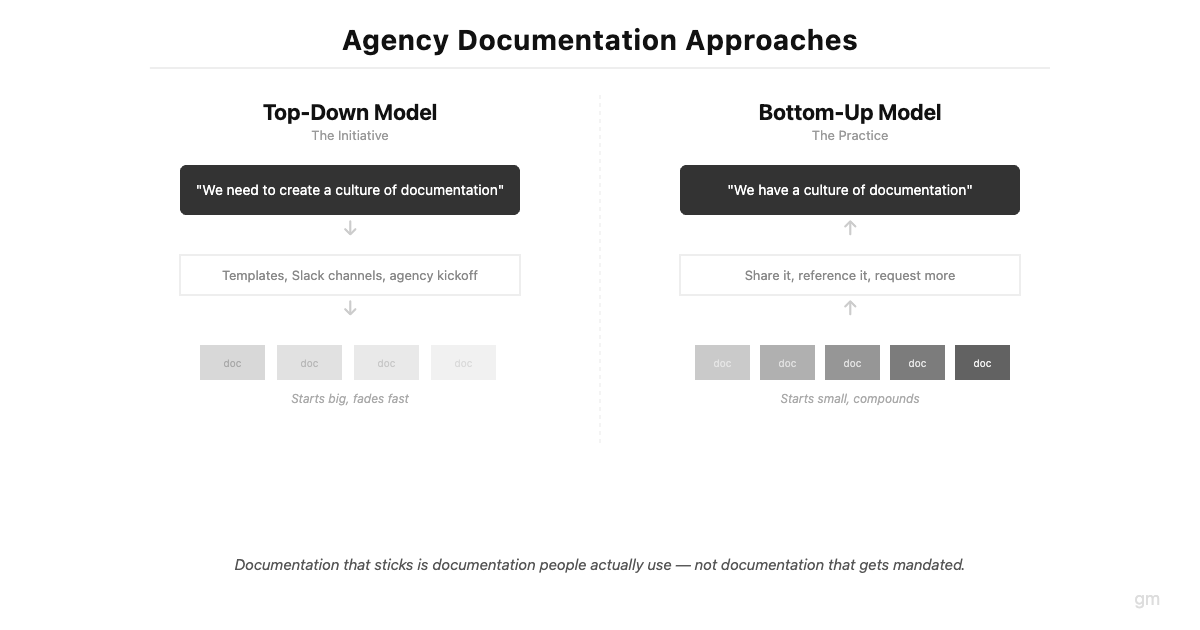
I’ve tried the top-down documentation rollout multiple times. Company-wide Notion buildouts. Mandatory SOP templates. Documentation sprints where everyone stops client work for a day to write everything down.
It can work — but the conditions have to be just right, and it’s a big time investment for something that’s set up to fail if the timing or buy-in isn’t there. Most of the time, it doesn’t survive first contact with a busy quarter.
What actually works is way less exciting. But it lasts.
The Bottom-Up Approach
Document something you do. Not everything — just one thing. That process you explained to a new hire last week? Record it next time. Fire up Loom, walk through it, run the transcript through AI, and you’ve got a usable SOP in minutes. Not a polished document — a functional one. That’s what matters.
When someone asks you a question, point them to the document instead of answering from memory. This is the hardest part because answering from memory is faster in the moment. But every time you answer verbally, you’re reinforcing the pattern that knowledge lives in people’s heads, not in systems.
Then tell your team to do the same. They don’t need to wait for a company-wide rollout to start writing things down. They don’t need a perfect template. They don’t need permission from leadership to document how they do their job.
Why This Works Better Than Top-Down
The people closest to the work will always build the most useful documentation. A director writing SOPs for their team’s daily tasks is guessing at best — the person who actually does the task knows the edge cases, the workarounds, the things that aren’t obvious until you’ve done it a hundred times.
Bottom-up documentation is also self-maintaining. When the person who wrote the doc is also the person using it, they update it naturally when things change. Top-down documentation goes stale the moment the initiative ends because nobody feels ownership over it.
The Culture Shift
This isn’t really a documentation strategy — it’s a behavior change. You’re shifting from “I’ll explain it when someone asks” to “I’ll write it down so nobody has to ask.” That shift doesn’t happen through a company meeting or a Slack announcement. It happens through modeling.
Start documenting your own work. When people see leadership actually using their own documentation — referencing it in meetings, linking to it instead of explaining things verbally, updating it when processes change — they’ll follow. Not because you told them to, but because they see it working.
The Minimum Viable System
You don’t need a documentation platform to start. A shared Google Drive folder with a clear naming convention works. A Notion workspace with one database works. A Slack channel where people post Loom recordings works.
The tool doesn’t matter. The habit matters. Pick whatever has the lowest barrier to entry for your team and start there. You can migrate to something more sophisticated later, once the habit is established.
Give your team permission to start and get out of the way. The best documentation systems aren’t designed — they’re grown.