


Content as Sawdust: How to Build a Content Engine From Work You’re Already Doing
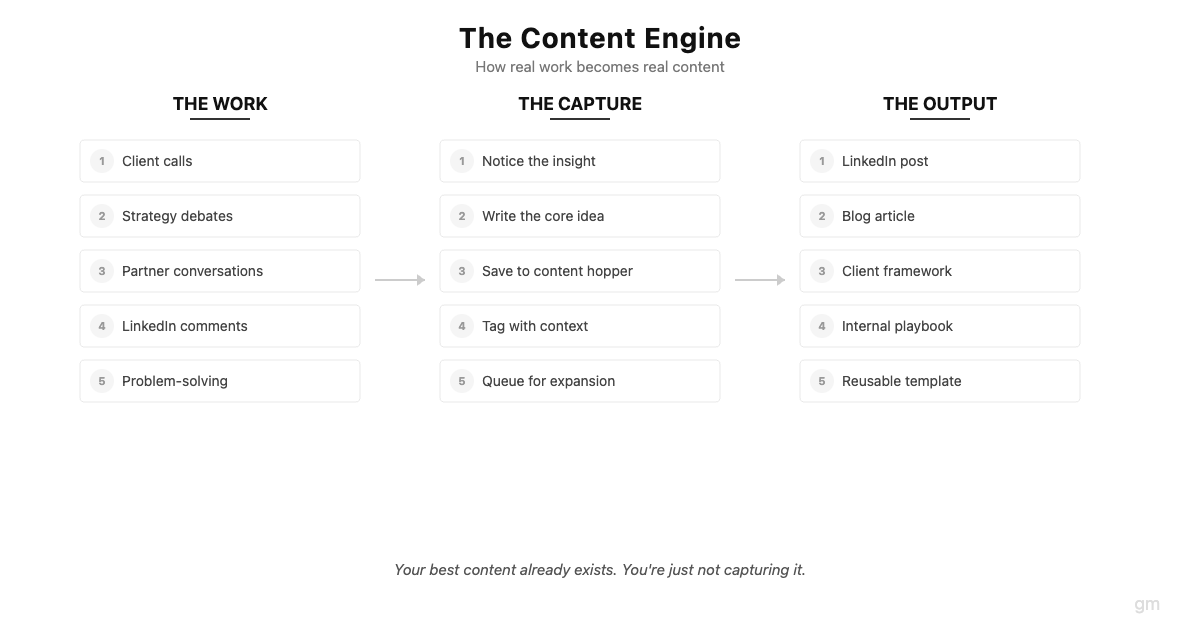
Most agencies and consultants struggle with content creation because they treat it as a separate workstream. You need to write blog posts, so you block time for blog writing. You need to post on LinkedIn, so you brainstorm post ideas. You need a newsletter, so you sit down and try to think of what to write about.
This approach burns out fast because content creation is competing with client work for your time and mental energy — and client work always wins.
There’s a better way. I call it the sawdust model, borrowed from a concept I first heard from a woodworker: the sawdust is the byproduct of the real work.
Your Content Already Exists
Think about everything you produce in the course of doing your actual job. Client strategy decks. Internal Slack debates about approach. Proposals that articulate your point of view. Meeting recaps where you explain your thinking. Feedback to your team about why something works or doesn’t.
All of that is content. It’s just trapped in formats and contexts that aren’t public-facing.
The sawdust model flips the traditional content creation process on its head. Instead of starting with “what should I write about?” you start with “what did I already think about this week?” Then you capture, reshape, and publish it.
How It Works in Practice
Capture everything. Record your client calls (with permission). Save your Slack rants. Screenshot your whiteboard sessions. Keep a running note on your phone for the insights that hit you at random moments. The raw material is everywhere — you just need a system to catch it.
Extract the insight. Most of your day-to-day work contains nuggets of genuine expertise buried inside context that’s too specific to share. The skill is pulling out the universal insight and reframing it for a broader audience. “We recommended the client shift budget from brand to demand because their awareness metrics plateaued” becomes “How to know when it’s time to shift from brand building to demand generation.”
Reshape and distribute. A single insight can become a LinkedIn post, a blog article, a newsletter section, a slide in a conference talk, and a talking point on a podcast. You’re not creating new content each time — you’re reshaping the same core idea for different formats and audiences.
The AI Accelerator
This is where AI has been a game-changer for me. I built a simple content pipeline where I dump voice memos, meeting notes, and rough drafts into a processing system. AI helps me extract the core insight, draft a first version in my voice, and suggest multiple format variations. What used to take me hours now takes minutes.
The key is that AI isn’t generating the ideas — I am, through the work I’m already doing. AI is just helping me turn those ideas into published content faster. The thinking is mine. The production is assisted.
Start This Week
Here’s my challenge to you: this week, pay attention to every moment where you explain something to a colleague, make a strategic recommendation to a client, or have a strong reaction to something in your industry. Write down the core insight in one sentence.
By Friday, you’ll have five to ten potential pieces of content — all generated from work you were going to do anyway. That’s not a content calendar. That’s a content engine. And unlike a content calendar, it doesn’t require you to manufacture ideas out of thin air.
Stop trying to create content. Start capturing the content that’s already being created as a byproduct of your expertise. The sawdust is right there — you just need to sweep it up.