


Where to Focus Your AI Adoption: A Practical Framework for Agencies
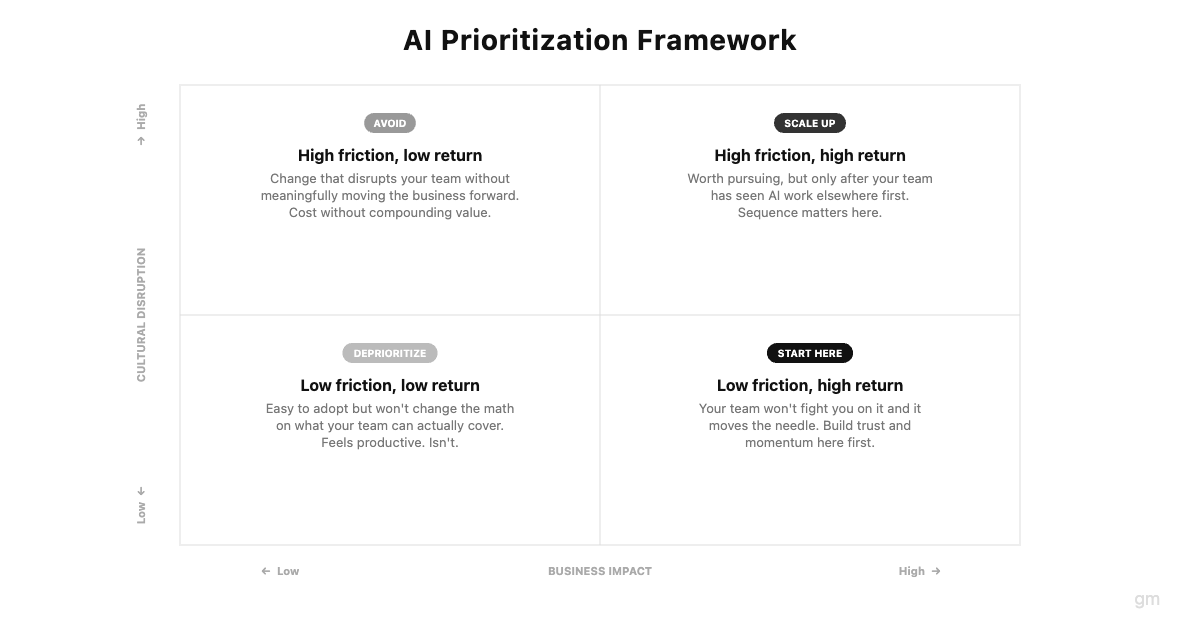
Every agency knows they need to adopt AI. Where to focus your investment is the hard part.
I was in a conversation this week with an agency leader who said something I hear constantly: “We know AI is important, but we don’t know where to start.” They’d experimented with a few tools, had some people using ChatGPT for copy drafts, but there was no coherent strategy. No framework for deciding what to prioritize.
Here’s how I think about it.
The Three Buckets
When I work with agencies on AI adoption, I break it into three categories based on where you’ll see the most immediate impact:
Bucket 1: Internal Operations. This is the lowest-risk, highest-ROI starting point. Think about all the repetitive, time-consuming tasks your team does every day that don’t require creative judgment: writing status reports, summarizing meeting notes, generating SOWs from templates, reformatting deliverables, building first-draft timelines. AI can handle 80% of this work in a fraction of the time.
The key insight here is that you’re not replacing anyone — you’re giving your team hours back. Hours they can spend on the strategic, creative work that clients actually value (and that your people actually enjoy doing).
Bucket 2: Client Delivery Enhancement. This is where AI starts touching the actual work product — but in a supporting role. AI-assisted research and competitive analysis. Automated first drafts that humans refine and elevate. Data analysis and reporting that used to take days but now takes minutes. Content variations and A/B testing at scale.
The trick with Bucket 2 is positioning it correctly with clients. Don’t hide it, but don’t lead with it either. Frame it as “we’ve invested in tools that let us deliver more strategic depth at the same price point” — not “we automated part of your deliverables.”
Bucket 3: New Service Lines. This is the most ambitious and the most differentiated. Can you build offerings that only exist because AI makes them possible? Think: real-time content optimization, predictive audience modeling, automated creative testing at a scale that would have been cost-prohibitive before. These are the services that let you charge a premium because nobody else is offering them yet.
Where to Start
My advice to almost every agency: start with Bucket 1 and stay there for at least 90 days before moving to Bucket 2. Here’s why:
Internal operations is where your team builds comfort and competency with AI tools without any client risk. It’s where you develop your internal point of view on what works and what doesn’t. And it’s where you generate the most immediate, measurable ROI — which gives you the budget and the organizational buy-in to invest in the more ambitious stuff.
The agencies I see struggling with AI adoption are almost always the ones who jumped straight to Bucket 2 or 3 without building the internal muscle first. They bought expensive tools, launched ambitious pilots, and then couldn’t sustain the effort because nobody on the team was comfortable enough with the technology to make it stick.
The 80/20 Rule
Here’s a practical exercise: have every team lead list the tasks their team spends the most time on each week. Rank them by time spent. Then ask: which of these could be 80% done by AI, with a human doing the final 20%?
That list is your AI adoption roadmap. Start at the top and work down. Don’t try to transform everything at once. Pick the highest-time-cost, lowest-creativity tasks and automate those first. Build confidence. Build competency. Then expand.
The agencies that win with AI won’t be the ones who adopted the most tools. They’ll be the ones who adopted the right tools in the right order and actually got their teams to use them.