



 Back to Blog
Managed Revenue Tells You Almost Nothing
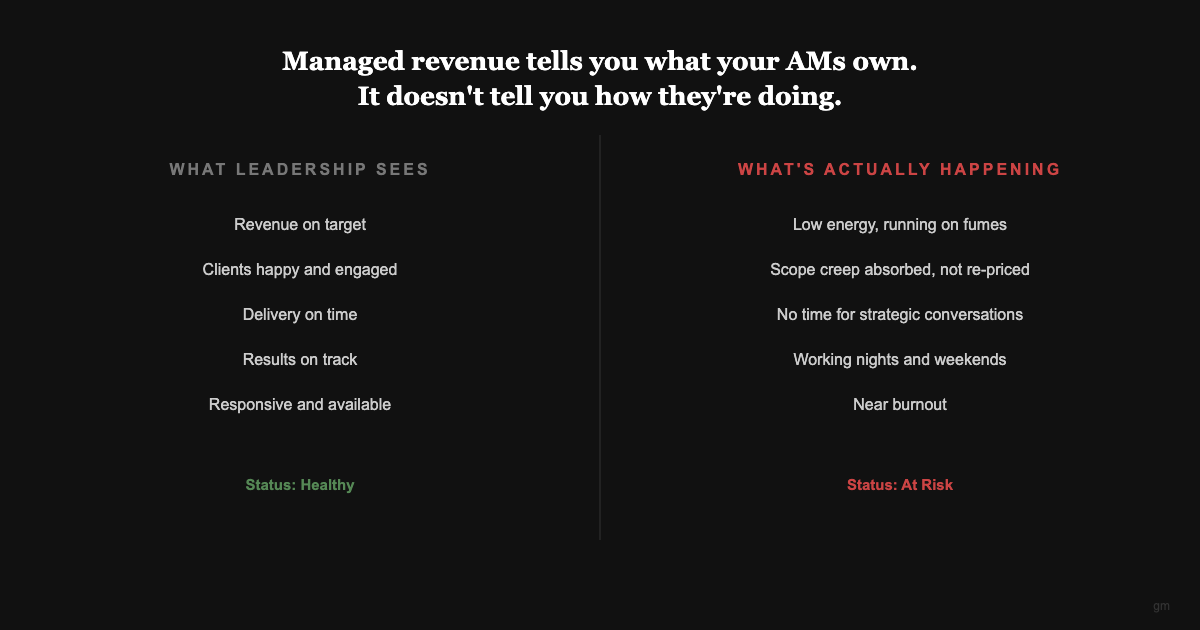
Here’s what your leadership dashboard won’t show you: an AM managing $80k a month across four clients can look completely fine in a standup. Revenue’s tracking. Churn’s flat. Everything appears stable. But the actual story—the one unfolding in their Slack notifications at 10:47pm on a Thursday—is something else entirely.
This is the lie we’ve been living with. Managed revenue is a number. It’s useful. It tells you what your AMs own. But it doesn’t tell you how they’re actually doing.
The Invisible Unraveling
When I started looking at account-level time tracking, I found things revenue never surfaced. One of my best AMs was averaging 55 hours a week. Not one week. Six weeks straight. No hand-raise. No conversation. Just a slow, quiet erosion of everything that should matter—sleep, recovery, capacity to think.
This is how it happens. It’s not dramatic. There’s no announcement. An account gets unpriced scope creeping onto the books. Another one adds a stakeholder, and suddenly a monthly check-in becomes weekly. A third client’s success manager leaves, and the relationship shifts onto an AM’s shoulders who never asked for it.
Each one is small. Each one is solvable. But they stack.
The AM starts staying up later. They get faster at context-switching, which feels like a win until it stops working. Response times get longer. Handoffs get messier. Strategic conversations—the kind that actually fuel account growth—get replaced by pure firefighting. They’re managing the chaos instead of building anything.
By the time you notice in a business review, the damage is already done.
Why AMs Don’t Say Anything
I learned this the hard way. Account managers don’t raise their hand when they’re drowning. That’s not a judgment—it’s how the role is wired. They own the account. The account owns them. There’s no separation because that separation is the job.
So they adjust. They absorb. They push back the strategic work one more week, then another month. They tell themselves it’s temporary. They stop sleeping well. They start getting short in Slack. The quality of their thinking—the thing that actually moves accounts forward—erodes slowly enough that nobody really sees it happen.
By the time leadership notices, it’s because something broke. A renewal got squirrelly. A contract didn’t expand when it should have. An AM suddenly asks to transfer accounts, or worse, they just leave. And you’re left wondering what changed.
Nothing changed. Everything changed six weeks ago. You just couldn’t see it.
What Managed Revenue Misses
Revenue is backward-looking. It tells you what already closed. It tells you what’s on the books. It doesn’t tell you anything about the conditions inside the account—the scope creep, the growing list of stakeholders, the unpriced work, the relationship that’s becoming transactional because there’s no time for anything else.
It doesn’t tell you about the 55-hour weeks. It doesn’t show you which accounts are burning hours at a rate that won’t scale, which relationships are being managed instead of grown, which AMs are one bad week away from breaking.
Start tracking time against accounts, and suddenly you see the real picture. You see which accounts are genuinely profitable after you account for the work it takes to keep them. You see which ones look good on a revenue chart but are actually running lean on margin. You see which AMs have real capacity to take on new business and which ones are already stretched.
More important—you see it early. Before burnout shows up as underperformance. Before churn. Before an AM walks.
The Friction People Worry About
I know what the pushback sounds like. “Our team will hate time tracking.” “It’ll feel like we don’t trust them.” “The overhead of implementing it will kill us.” “We have a culture we want to protect.”
All of that is real. I’m not minimizing it. Time tracking comes with friction. It requires implementation. It feels uncomfortable at first—for leaders and AMs both.
But here’s what’s also real: you’re currently making decisions about your business and your team based on incomplete information. You’re looking at revenue and pretending it tells the whole story. You’re trusting your gut when your gut can’t possibly see what’s happening inside a team member’s week.
The upside of actually seeing what’s happening—of understanding where the real capacity is, where the real risk is, where the real opportunities are—is worth the friction it takes to surface it.
Start Where the Problem Is
You don’t have to boil the ocean. You don’t need a massive system. Start with the accounts where you know something’s off. Start with the AMs you’re worried about. Track time for two weeks. Look at the pattern.
You’ll see things immediately. I promise.
Maybe it’s that one renewal that’s been taking three times the expected effort. Maybe it’s a new account you thought would be straightforward but is eating hours like crazy. Maybe it’s exactly what I found—an AM running on fumes while looking fine in a revenue meeting.
Once you see it, you can actually do something about it. You can shift work. You can reprice. You can hire. You can say no to bad accounts. You can have a real conversation instead of wondering why an AM’s energy is off.
Managed revenue isn’t wrong. It’s just incomplete. It’s one lens. And if it’s your only lens, you’re running blind on the thing that actually matters—the health and capacity of the people doing the work.
The damage compounds quietly until it’s suddenly loud. Start looking now.