



 Back to Blog
People as Infrastructure: Why Your Agency Breaks When Key Players Leave
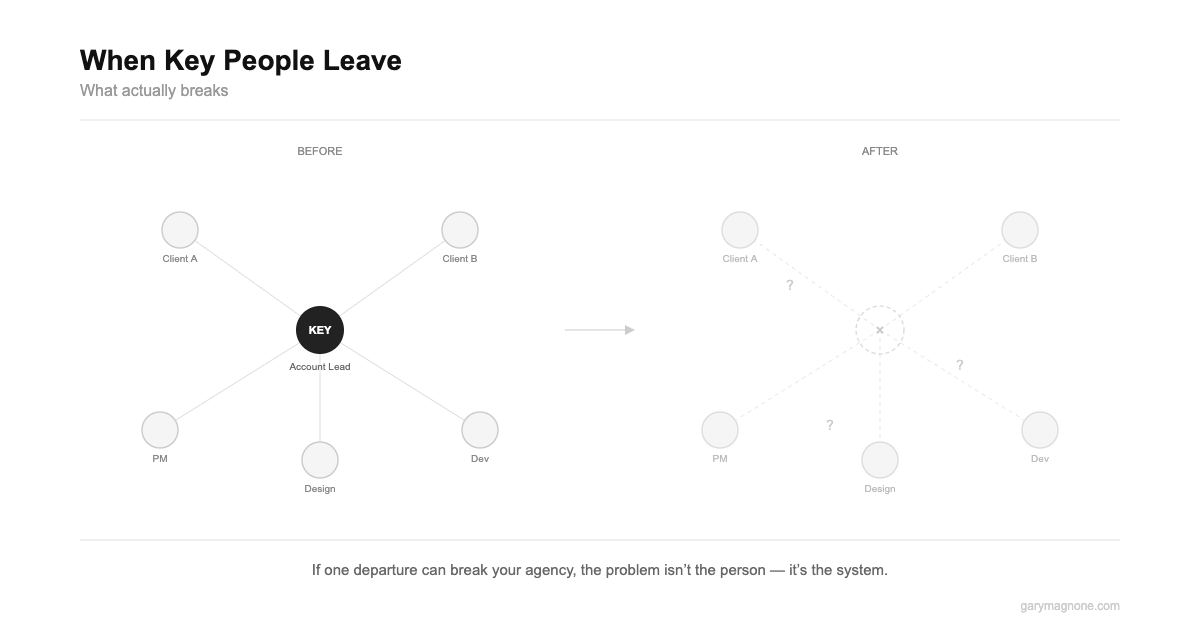
Your senior account lead just quit — and suddenly you realize they’re the only person who knows how your best clients actually work.
No handoff doc. No SOPs. No process to fall back on. The way they managed escalations, knew which clients needed a call vs. an email, kept the scope from creeping — all of it lived in their head. None of it was written down because there was never time to write it down.
If this scenario sounds familiar, you’re not alone. It’s one of the most common — and most expensive — failure modes I see across agencies of every size.
The Hidden Dependency
It’s not just the account lead. It’s the founder who ships every proposal because nobody else has the context. It’s the PM holding together nineteen accounts and three departments on duct tape and coffee. It’s the dev everyone DMs because nothing ever gets documented — we’ve all been in that Slack channel.
We call this “culture.” Being scrappy. All hands on deck. But let’s call it what it actually is: people as infrastructure.
When your processes, institutional knowledge, and client relationships all live inside individual people’s heads, those people aren’t just employees — they’re load-bearing walls. And the building works fine until one of those walls decides it’s done.
Why It Happens
Agencies are uniquely vulnerable to this pattern for a few reasons. First, the work is relationship-driven. Clients develop trust with individual people, not systems. Second, agencies tend to run lean — there’s rarely “extra” capacity to document things when everyone’s billing hours. Third, the knowledge that matters most (how a client thinks, what sets them off, where the real scope boundaries are) is messy and contextual. It doesn’t fit neatly into a template.
So it accumulates as tribal knowledge. And tribal knowledge works — until the tribe member leaves.
The Real Cost
When a key person walks out the door, the damage isn’t just the cost of replacing them. It’s the client churn that follows. It’s the three months of reduced efficiency while someone new figures out what “the usual process” actually means. It’s the proposals that don’t go out because nobody else knows how to price the work. It’s the subtle deterioration of client confidence when things start slipping through the cracks.
I’ve seen agencies lose six-figure accounts within 90 days of a key departure — not because the replacement was bad, but because the knowledge transfer was nonexistent.
What to Do About It
The fix isn’t a massive documentation initiative (I’ve tried those — they usually die within a quarter). The fix is building a culture where knowledge capture happens as a byproduct of doing the work.
Here’s what that looks like in practice:
Record everything worth repeating. If you explain something to a colleague, you should be recording it. Loom, screen share, voice memo — the medium doesn’t matter. Run the recording through AI to get a clean transcript and you’ve got an SOP in minutes, not hours.
Build client operating manuals, not just project plans. Every client should have a living document that captures how they actually work — their communication preferences, approval chains, hot buttons, scope boundaries. This is the knowledge that walks out the door when someone quits.
Cross-train ruthlessly. No single person should be the only one who can do a critical function. If your team can’t survive a two-week vacation from any individual, you have a structural problem.
Audit your single points of failure. Walk through your org chart and ask: if this person left tomorrow, what breaks? The answers will tell you where to focus.
The Bottom Line
Your agency’s resilience shouldn’t depend on any one person’s decision to stay. If it does, you don’t have a people problem — you have an infrastructure problem. And unlike actual infrastructure, the fix doesn’t require a capital investment. It requires a mindset shift: from treating knowledge as something people carry to treating it as something the organization owns.
Start small. Document one thing today that currently lives only in your head. Then ask your team to do the same. That’s not a documentation initiative — that’s just building a business that can survive its own success.